When Oral and Facial Surgery of Pensacola relocated to their new facility, they needed a reliable, code-compliant medical gas system that could support their full range of surgical operations. The team at S.E. Tradesmen Plumbing & Gas was proud to deliver a complete turnkey installation that ensures safety, performance, and long-term reliability.
Project Overview
Our scope included a full medical gas system installation consisting of oxygen (O₂), nitrous oxide (N₂O), and medical vacuum. The new system serves 18 outlets throughout the clinic, supporting surgical suites, procedure rooms, and recovery areas.
To achieve this, our crew installed new Type L copper piping throughout the building and added key system components, including:
- A changeover manifold for seamless cylinder transitions
- A zone valve box for isolation and safety control
- A vacuum pump and source equipment to maintain consistent suction and pressure levels
One of the existing bathrooms was fully demolished and converted into a dedicated source equipment room, ensuring optimal access, ventilation, and compliance with NFPA 99 standards.
Our Team
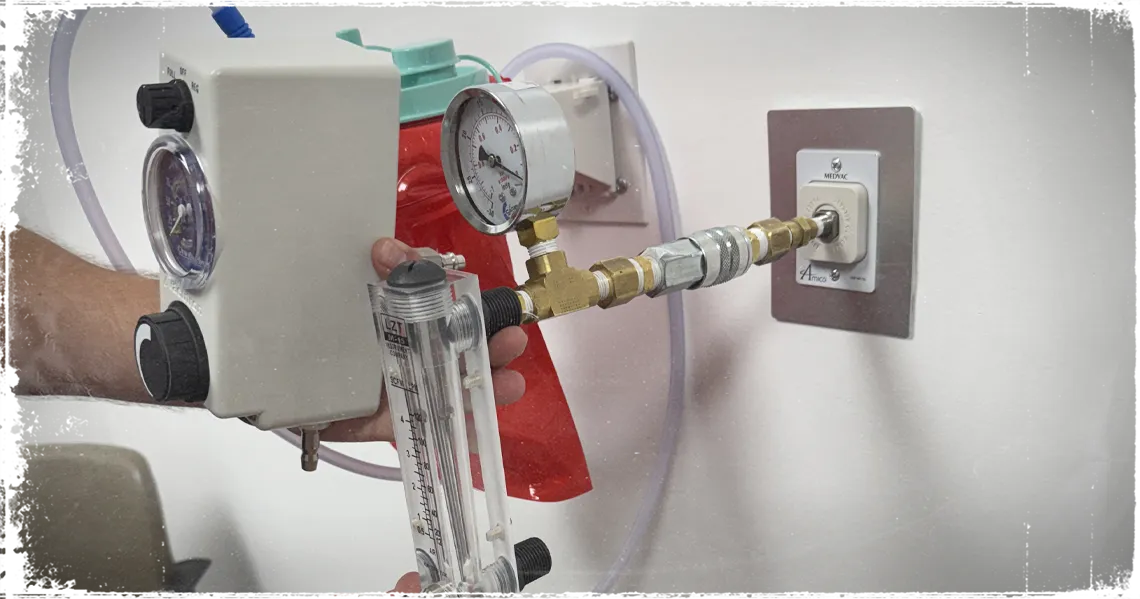
This project was led by Michael Beck, who served as Foreman and 6010 Installer, overseeing all aspects of system layout and installation.
Supporting him was Matt Hardy, Journeyman 6010 Installer, along with apprentices Brendan and Trey, whose attention to detail and craftsmanship helped ensure a clean, organized system.
Brandon Flowers, Project Manager, coordinated between OFS, the design team, and the certifying agency to keep the project on schedule and within scope.
Final certification and testing were completed by Hunter Montgomery with Anatech, Inc., ensuring the system meets all NFPA 99 and ASSE 6010 standards for medical gas systems.
What Is a Medical Gas System?
Medical gas systems provide critical life-support gases used in healthcare and dental environments. Common gases include:
- Oxygen (O₂): Essential for patient breathing and anesthesia systems.
- Nitrous Oxide (N₂O): Commonly used for sedation in surgical and dental procedures.
- Medical Vacuum: Removes fluids, gases, and particulates from the surgical field.
Each gas is delivered through a dedicated pipeline network designed to maintain purity, pressure, and reliability. Any failure in this system can pose serious risks, which is why proper design, installation, and certification are so important.
What Does It Take to Install Medical Gas?
Installing medical gas systems requires specialized training and certification under the ASSE 6010 standard, as well as compliance with NFPA 99: Health Care Facilities Code.
Every joint is brazed under nitrogen purge to prevent oxidation and ensure system cleanliness. Installers must also pressure test and verify line purity before certification. Beyond technical skill, successful projects demand coordination, precision, and strict documentation to ensure safety and performance.
We take pride in being one of the few plumbing companies with certified medical gas installers in the Pensacola region, capable of delivering compliant systems for hospitals, surgical centers, dental offices, and medical clinics.
To learn more, check out Medical Gas Plumbing.